Introduction
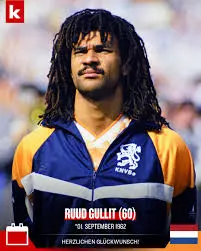
Ruud Gullit is a name synonymous with success in the world of football. A talented playmaker, Gullit not only made his mark as an exceptional player but also as a successful coach. His contribution to football, especially during the 1980s and 90s, is significant, comprising a combination of skill, charisma, and leadership that remains influential to this day. With his unique style and approach to the game, Gullit has influenced generations of players, making him a noteworthy figure in football history.
A Stellar Playing Career
Born on September 1, 1962, in Amsterdam, Ruud Gullit began his professional career at HFC Haarlem before moving to Feyenoord. However, it was at PSV Eindhoven where he truly shone, helping the team to win multiple league titles. His performance in the Eredivisie soon earned him a transfer to AC Milan in 1987, where he played alongside legends like Marco van Basten and Franco Baresi. During his time at Milan, Gullit won three Serie A titles and the prestigious European Cup in 1989 and 1990, establishing Milan as the dominant force in European football.
Internationally, Gullit was a key player for the Netherlands national team, contributing significantly to their victory in the 1988 UEFA European Championship. His physical prowess and technical skills allowed him to play different positions, showcasing his versatility on the field.
Transition to Management
After retiring as a player in 1998, Gullit transitioned into coaching, taking on various roles across Europe and the United States, including positions at Chelsea and the Los Angeles Galaxy. His managerial style reflects his philosophy as a player—emphasising creativity, resilience, and team spirit. Although his coaching career has had its ups and downs, Gullit’s insights into the game are respected, and he continues to contribute to football through commentary and analysis.
The Lasting Impact
Ruud Gullit’s impact on football is enduring. He inspired a generation of players with his unique blend of skill and personality. Beyond his accolades and achievements, Gullit is known as a pioneer for a new style of football that values flair and elegance, pushing the boundaries of what is expected from footballers. His efforts off the pitch, including advocacy for issues like diversity in sports, further cement his legacy.
Conclusion
In a continually evolving sport, Ruud Gullit remains a towering figure whose contributions have shaped modern football. His legacy is not only evident in his wins, goals, and trophies but in the spirit and philosophy he brought to the game. As we look to the future, Gullit’s story reminds us of the true essence of football: a celebration of talent, teamwork, and the joy of the beautiful game.